
Features
What Logwise reads in your logs.
Everything on this page is in the app today, with MoTeC M1 logs. It only uses what's logged: where a check needs a channel you don't log, it says "log X to unlock this" instead of guessing.
The debrief, and wheelspin
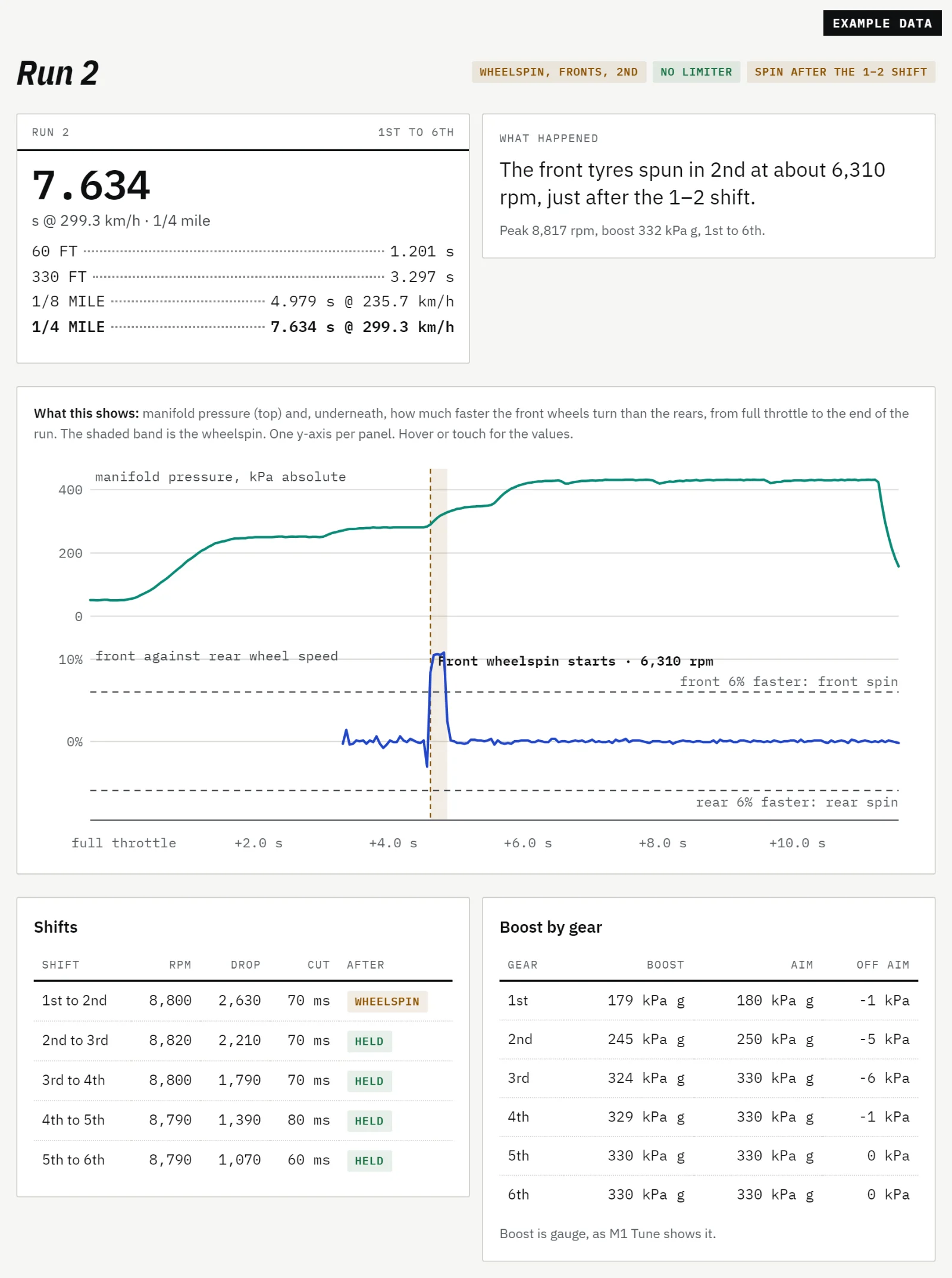
Logwise finds each full-throttle run (over 90% throttle, above 2,500 rpm and 20 km/h; burnouts don't count) and shows it as a timing slip, best first.
- Pass times from GPS or ground speed: 60 ft, 330 ft, 1/8 and 1/4 mile, and trap speeds, with a 0.3 m rollout like the strip's beams.
- Wheelspin, two ways. With front and rear wheel speeds: one axle running away from the other, or both pulling away from GPS. With one speed sensor: speed climbing faster than the car can accelerate. A hard 2.3 g launch isn't spin; a sensor glitch isn't either.
- Shifts: rpm, drop, cut time and whether the tyres held after each one.
- Boost against aim in every gear, as gauge pressure, the way M1 Tune shows it.
Health checks that say what it should be
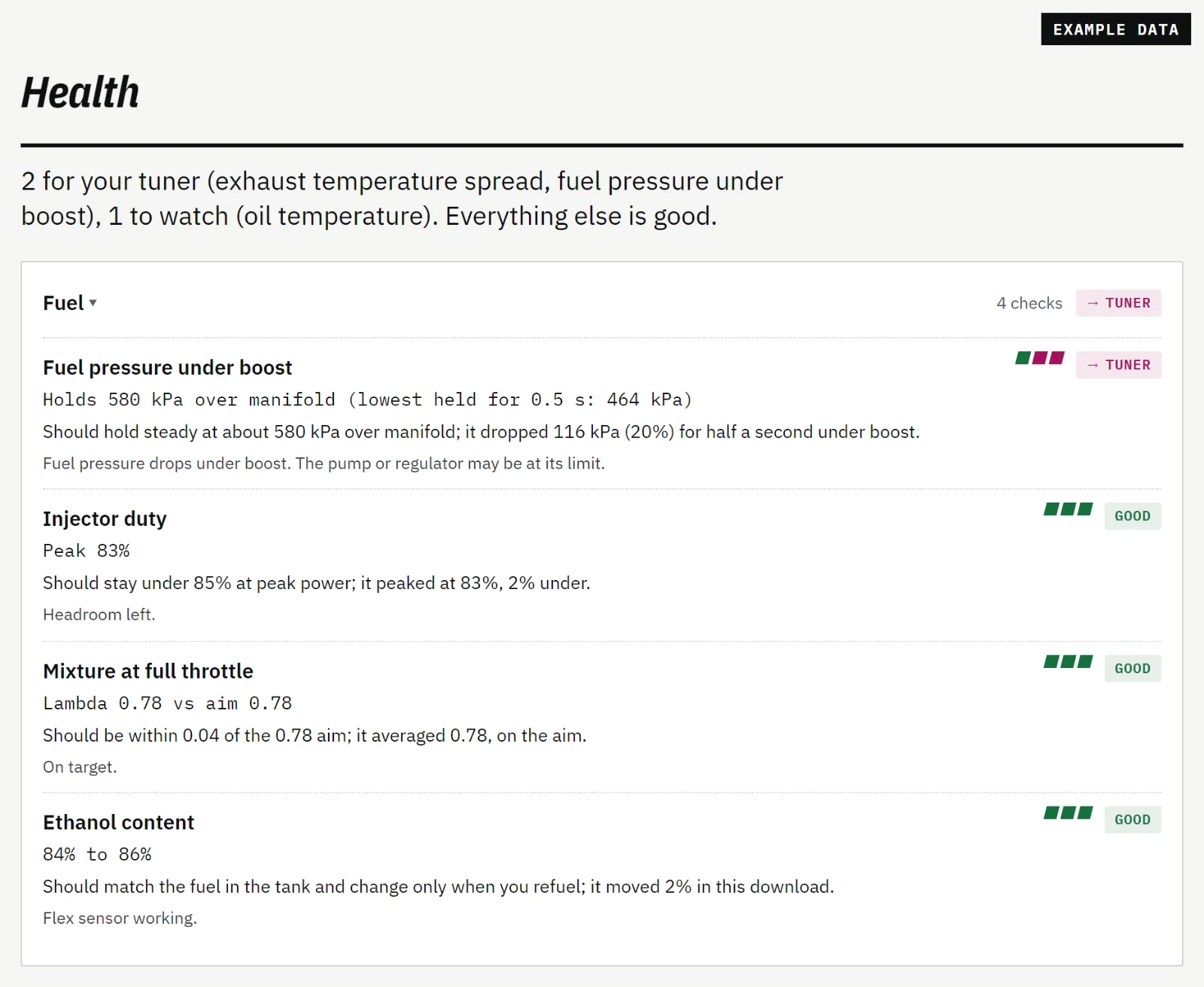
Every check gives a plain answer (good, watch it, or take it to your tuner) and a line saying what it should be and how far off it was: "Should stay under 100 °C; it peaked at 96.3 °C, 3.7 °C under."
- Engine: oil pressure at hot idle and full throttle, oil and coolant temperature, intake air, exhaust temperature spread between cylinders, the rev limiter, over-revs and money shifts, hard use before warm-up, time above an rpm.
- Fuel: fuel pressure under boost, injector duty, mixture against aim, lean events, fuel trims, ethanol content.
- Ignition and electrics: knock by cylinder, crank and cam sync, battery voltage.
- Sensors: one that reads a single fixed value is a default, not a measurement, and Logwise says so.
Each download keeps its own result, so the health history shows when something changed.
Every gearbox
The same symptom means different things on different gearboxes, so the car profile has a gearbox type and every check knows it. Logwise suggests the type from the logs; you confirm it. It only works out a gear from rpm and speed when the engine is locked to the wheels: never through an open converter or a CVT.
| Gearbox | What Logwise checks |
|---|---|
| Manual | Launches (clean, bog or spin), shifts, clutch slip under load read from the gearbox side so tyre spin never counts, money shifts. |
| Sequential | Shift cut time against when the gear engages, downshift blips, clutch slip. |
| Dual-clutch (DCT) | Slip on each clutch, shift times from the gearbox controller, torque reduction, gearbox temperature. |
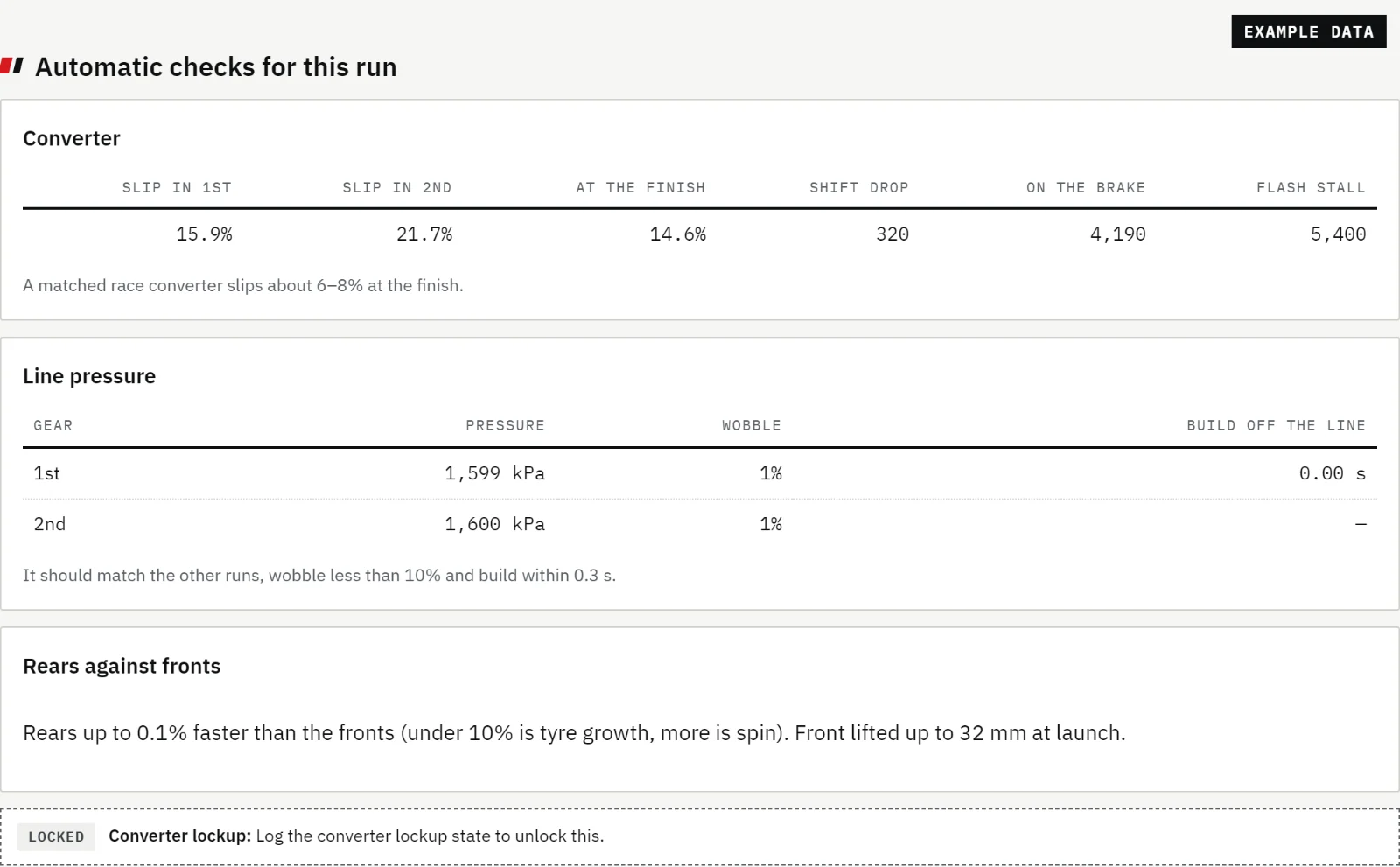
| Automatic | Converter slip by gear and at the finish (loose, matched or tight), flash stall, lockup, line pressure, gearbox temperature. |
| Powerglide | The two-speed checks: converter slip, the rpm drop at the 1-2 shift, flash stall off the transbrake, line pressure in each gear and how fast it builds. |
| CVT | Health checks and gearbox temperature. The gear comes only from a logged Gear channel; belt slip needs the gearbox controller's own data. |
Every drivetrain
All-wheel, rear-wheel and front-wheel drive each get their own checks on top of the gearbox's.
Front against rear
Which axle spun, calibrated from cruising so tyre sizes don't fool it, and the centre diff when it's logged.
Rears against fronts
Rear spin by gear, telling slick growth (under 10%) from real spin, and how far the front lifted at launch when ride height is logged.
Fronts against rears
Front spin, and torque steer from the steering angle when it's logged.
Dyno mode
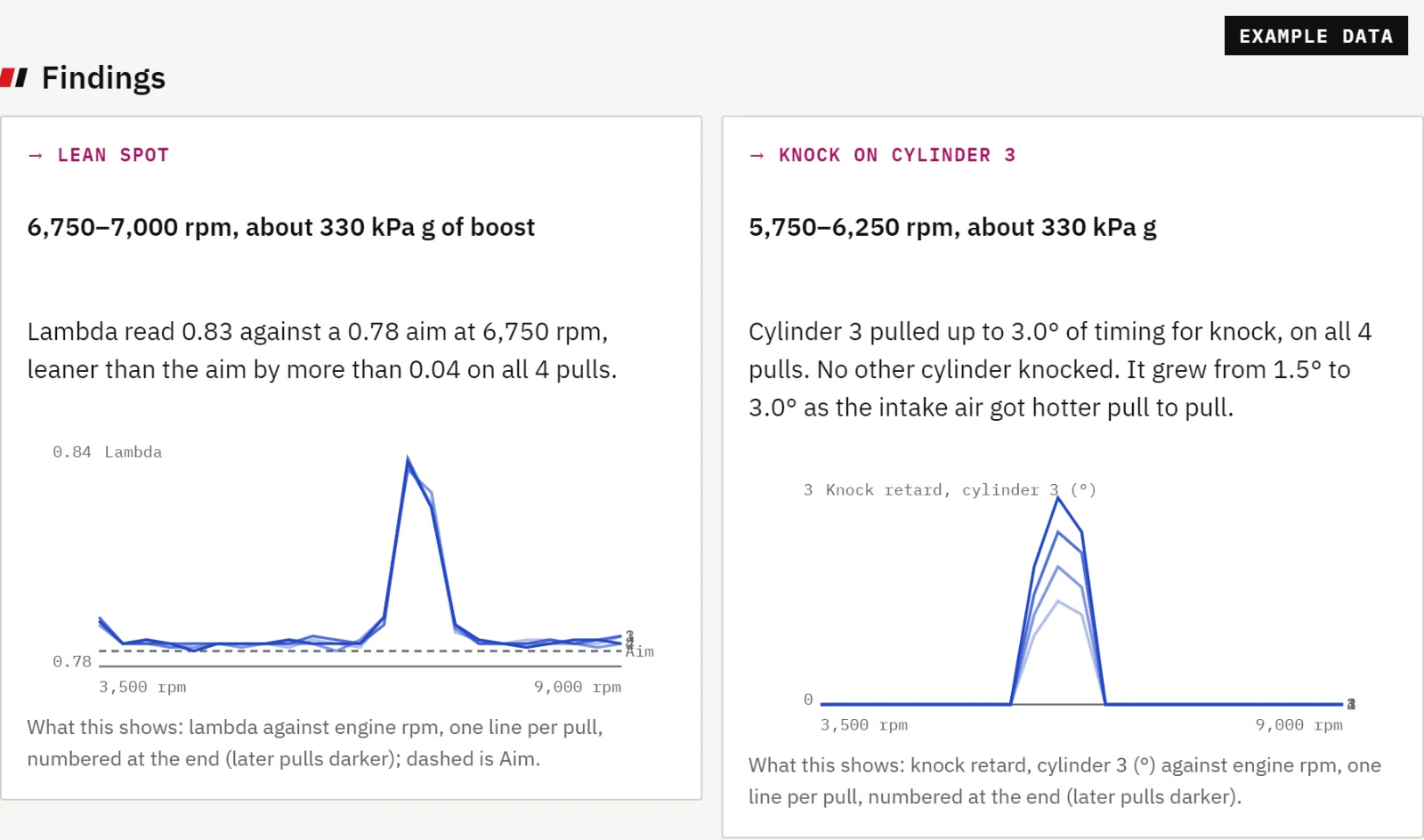
Logwise spots a dyno day in the logs (wheels turning with GPS standing still, or long single-gear sweeps) and asks you to confirm it. Then it reads each pull by rpm.
- Lean spots, knock by cylinder, boost overshoot, creep and taper.
- Heat soak pull to pull, and the timing it cost.
- Fuel pressure, injector duty, exhaust temperatures, oil pressure against rpm, cam against aim.
- How repeatable the pulls were, and settings side by side.
- Import the dyno sheet (a CSV, kW or hp, Nm or lb ft) to get real best shift points.
Everything goes on a touch-up list for your tuner: what was seen and where, never how to change fuel or ignition. Save the day as the car's day 1 baseline, and compare later race days to it.
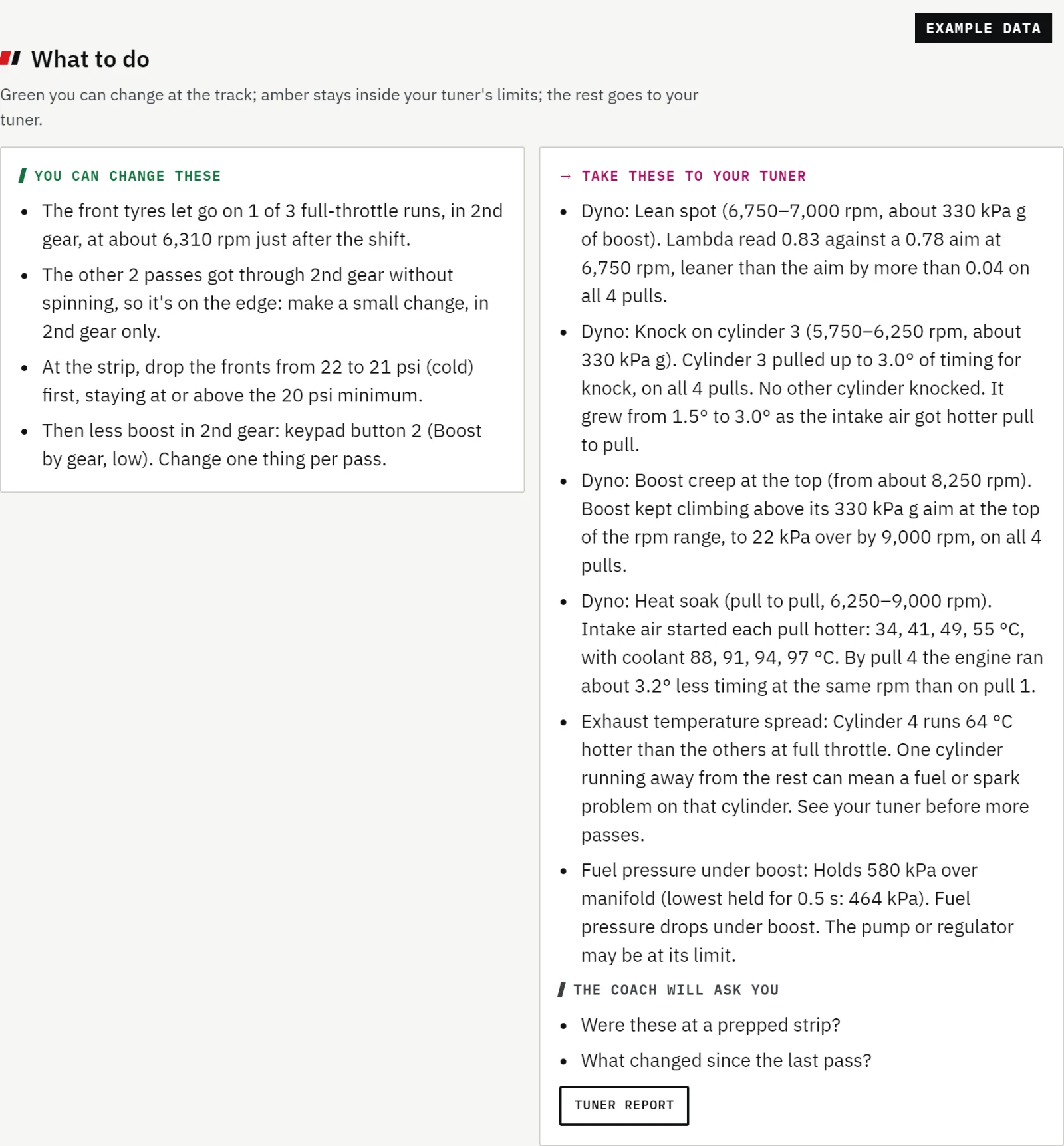
Strip day coaching
Drag and roll coaching is for the strip, and Logwise won't help make a car faster on the street. Mark a download as a Strip day (it's off by default) and the driving coaching switches on:
- What to change for traction: tyre pressures, launch rpm, boost by gear, one thing per pass.
- Shift points against an estimated best from your pull curve, or the real best from a dyno sheet.
- Launches: rpm, boost at release, and how long boost took to build.
- How consistent your passes were, and ET corrected for the weather (an estimate).
Without a Strip day you still see every run, every health check and everything for your tuner.
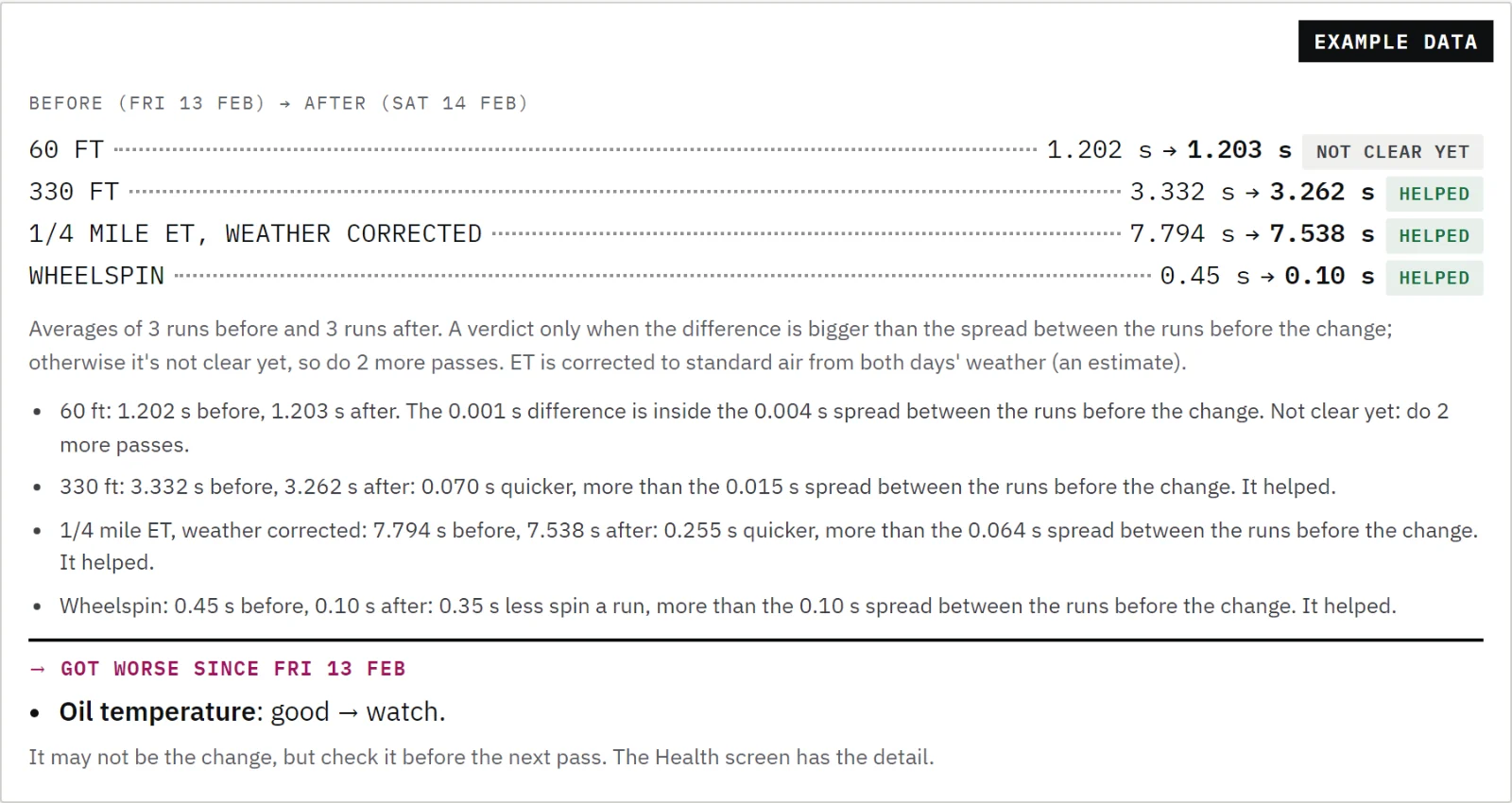
The event log: did it help?
For each download, note the venue, the weather (filled in from the ambient sensors when they're logged), what changed since last time and how it felt. The list of changes fits your car: tyre pressures, launch rpm, boost, nitrous, shift points, the converter, line pressure, suspension, ethanol, or a new tune from your tuner.
Logwise compares the runs before and after on 60 ft, 330 ft, ET, wheelspin, shift rpm and boost against aim. It only says "helped" or "made it worse" when the difference is bigger than the spread between the runs before. Otherwise: not clear yet, do 2 more passes. If you changed three things at once, it says it can't tell which one did it.
Pass comparisons are for strip days only. A health check that got worse always shows.
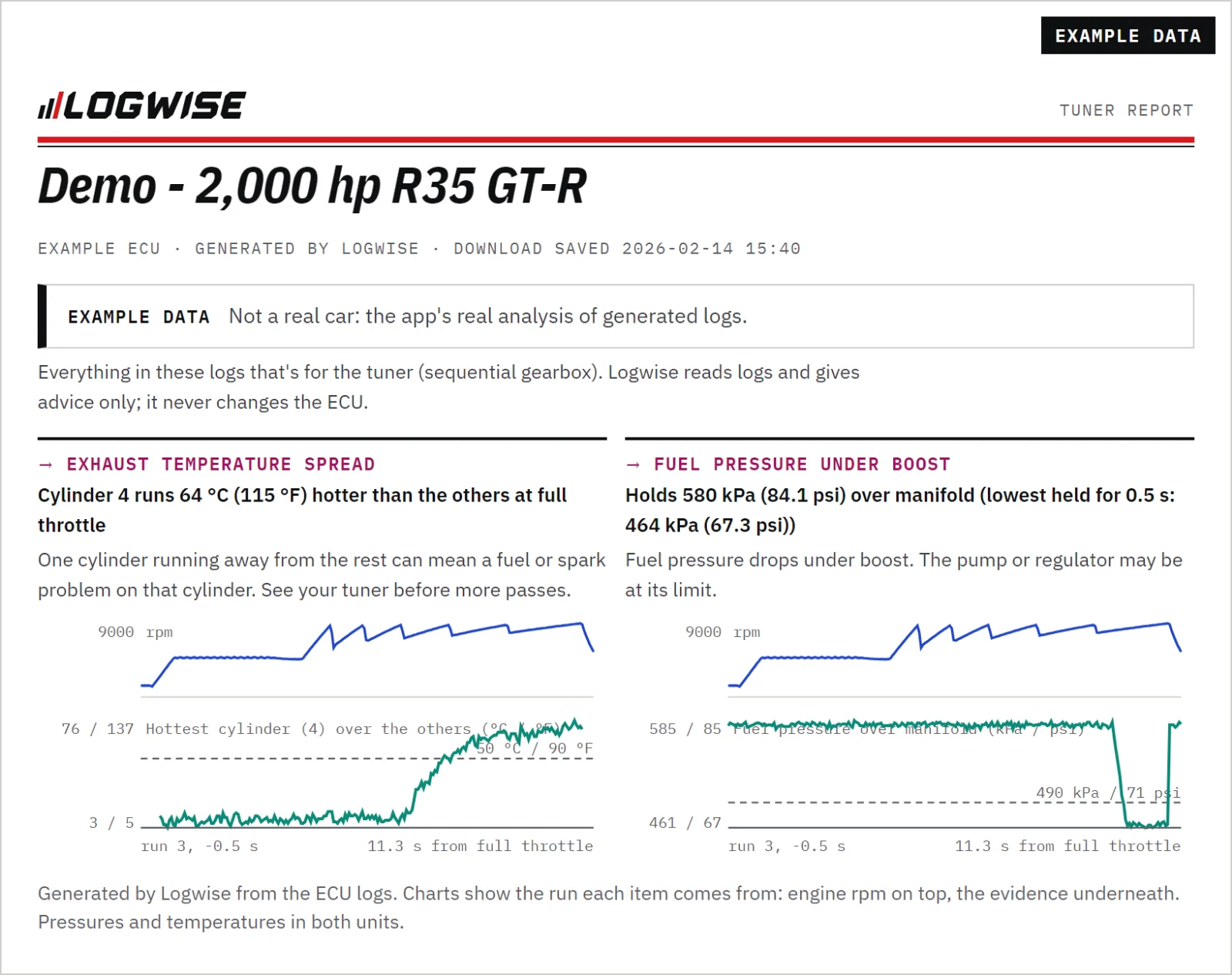
Tuner report and checklist
One printable page for your tuner: each item with the chart from the run that proves it, in both kPa and psi, °C and °F, so it reads the same whichever they use.
A "check before the next event" checklist for you or your mechanic, and a touch-up list after a dyno day. Print them, or save as PDF to send.
kPa or psi, your call
Boost, fuel and oil pressure in kPa or psi; temperatures in °C or °F; speed in km/h or mph. Boost is gauge pressure, as M1 Tune shows it. Tyre pressures are always psi.
Works offline at the track
After the first visit, the app and the example cars open with no internet. Trackside is built for a phone between rounds, with Sunlight mode for full sun. Move a car to another laptop with an export file (never the logs).
Try it on an example car
Three fictional cars with generated logs: a 2,000 hp sequential AWD GT-R, a Powerglide drag car and a dual-clutch AWD street car. Clearly labelled, and analysed by the same app.